Forms of Freedom: The Art and Design of Black and Indigenous Creative Collectives

Emery Petchauer, Ruth Nicole Brown


Abstract

"Forms of Freedom" was a two-year participatory research project that explored how Black and Indigenous creative collectives evolve to sustain themselves over time. To explore this question, we invited members of three collectives to assemble for visitation, reflection, skill, and idea exchange sessions over a nine-month period, and over Zoom, due to the global pandemic. These collectives were Saving Our Lives Hear Our Truths, Fire in Little Africa/The Space Program, and The Aadizookaan. Months later as the pandemic receded, we reassembled these collectives for a People's Sound Studio collaboration in New York City. The People’s Sound Studio was an opportunity to create together in person, practicing in public how we move, sound, organize, and collectivize in the now. Our assembly was held by care and familiarity among us as convenors and among our collaborators, sharing genuine desire to strengthen existing connections, deepen the love, and expand solidarities across new relations. We understood this assembly as a minor experiment in Black study (Harney & Moten, 2013), one that emphasized aesthetic performance. This exploration generated a shared archive of materials from participants and ourselves as artist-organizers: ritual performance scripts, sound compositions, conversation recordings, voice memos, video montages, in situ practices, photographs, and beadwork. We assembled these creations into an ensemble, an apparatus of movements suspended in time by digital space (www.formsoffreedom.com). This ensemble provides multivocal, incommensurable performances propelled from the initial research question.

Forms of Freedom: The Art and Design of Black and Indigenous Creative Collectives

Published:

February 27, 2026 (675 views)

License:


Forms of Freedom: The Art and Design of Black and Indigenous Creative Collectives © 2026 by Emery Petchauer and Ruth Nicole Brown is licensed under CC-BY-NC-SA 4.0

SIGNIFICANCE and context 

Forms of Freedom was a two-year participatory research project that explored how Black and Indigenous collectives sustain themselves over time. We understand collectives in this context as groups who organize themselves and others through art, cultural production, and performance toward otherwise, visionary, and sometimes radical ends. Collectives build on and extend many heritage, political, and activist traditions. These include African American solidarity economies (Nembhard, 2014), Black feminisms (The Combahee River Collective, 1977), and more.

We invited members of three collectives to assemble for visitation, reflection, skill, and idea exchange sessions over a nine-month period, and over Zoom, due to the global pandemic. These collectives were The Aadizookaan, Saving Our Lives Hear Our Truths, and Fire in Little Africa (Figures 1, 2, and 3). 

Figure 1. The AADIZOOKAAN is a collective in southwest Detroit that uses guidance from ancestral Indigenous-based knowledge systems for cultural production and storytelling experiences through traditional, contemporary, and experimental media, music, film, and design. “The Aadizookaan” means “the sacred spirit of the story” in the language of the Anishinabe, the original caretakers of the Waawiyatanong/Detroit lands.
Graphic design of the word "AADIZOOKAAN" in embellished capital letters, surrounded by drawings of paintbrushes, spray paint cans, speakers, arrow heads and arrow feathers. Above the word is a drawing of a person with two braids wearing a kerchief tied over nose and mouth like a mask. Behind the person is an outline of the sun.
- https://alliedmedia.org/projects/the-aadizookaan
Figure 2. Saving Our Lives Hear Our Truths is a Black girlhood visionary and performative space that has evolved through analogue, physical, and digital modes since 2006. This evolution has taken the form of Black Girl Genius Week; The Institute for Whole Persons, Communities, & Creativity; and place-based SOLHOT sessions.
Graphic design of the letters "solhot." The letters are black and lowercase and the "h" ends with a swirl that drops below the line of the letters. Next to the "S" is an artistic rendering of a brown-skinned girl's face; she has an afro with pink flowers in it.
- https://www.solhot.com/
Figure 3. Fire in Little Africa is a collaborative hip-hop album and documentary commemorating Black Wall Street in Tulsa, OK, 100 years after its bombing. Fire in Little Africa evolved out of The Space Program, an award-winning Black participatory research project and hip-hop album.
Graphic rendering of the words "FIRE IN LITTLE AFRICA." The letters are all capitalized and are laid over the shape of a flame. The flame is orange with black letters inside that spell "FILA."
- fireinlittleafrica.com

As a practice of Black study (Harney & Moten, 2013), our assembly was held by the care and familiarity that existed among most members of these collectives prior to this project. We informally mapped the relational, land, institutional, creative, and collective ties as we began this experience together (Figure 4). Among our collaborators and ourselves was – and remains – genuine desire to strengthen existing connections, deepen the love, and expand solidarities toward the not-yet (van Hesswijk et al., 2021) and what-if possibilities (Maparyan, 2012). 

Figure 4. Map of relationships among people, collectives, and spaces at the start of this project. We surfaced these connections in response to the following conversation prompt: Tell a story about an experience you had with someone else in this group that makes you excited they are here today. The green circles are collectives. The purple spaces are lands and institutions elicited by our stories. The lines between us represent connections also elicited by our stories. We understand these existing relationships, some dating back to over a decade, created the conditions of desire, trust, and solidarity for this project.
Large grey circle with small blue and yellow sticky notes with line drawing connections between them. The green sticky notes have organization names in each: SOLHOT, Fire in Little Africa, The Space Program, After School Beats, THE AADZOOKIAAN. The blue sticky notes each have the name of a person.
Esme R. Bailey
Figure 5. Screen shot of Forms of Freedom collaborators during first exchange session. The virtual space/image of Zoom is a reminder of the peak pandemic-time of this project. Though sheltering in place was isolating for each of us, it also afforded the slowness and deep contemplation of this project. From L to R: Esmé R. Bailey, Emery Petchauer, Ruth Nicole Brown, Blair Ebony Smith, Jacobi Ryan, Sacramento Knoxx, Jessica Robinson, Am’re Ford, Stevie Johnson, Mark C. Francis II.
Screen shot image of 10 people smiling during a Zoom meeting.

RESEARCH process & Black aesthetic methodologies

We conceptualized this project as a collective case study (Stake, 2005) given our training in qualitative methods. This design allowed a focus on three collectives that indeed had sustained themselves over many years, working through practical challenges and maneuvering through organizational structures built on anti-Blackness, anti-Indigeneity, and patriarchy. We knew there was much to learn from, with, and across these collectives given our varied knowledge and experiences with them. (sidenote: Ruth Nicole started SOLHOT in 2006, Emery has ongoing collaborations with members of The Aadizookaan, and both Ruth Nicole and Emery love and admire Fire in Little Africa / The Space Program. Our collaborators across these collectives were Esmé R. Bailey, Am’re Ford, Mark C. Francis II, Stevie “Dr. View” Johnson, Sacramento Knoxx, Dr. Jessica Robinson, Dr. Blair Ebony Smith, and Jacobi Ryan. ) We also staged strategic interventions to the fixity of social science and sociological underpinning of case study design.

First, we intervened upon the objectification of research participants (i.e., making them objects of study) by creating procedures that would share responsibility with them for shaping the direction of the project. Taking inspiration from how collectives organized internally, we rotated responsibilities for facilitating exchange sessions around the collectives. With leadership thus shared, our exchange session focused on topics including integrity, break-ups, vision, and wholeness. Most importantly, the sessions also allowed each collective to process in real time how they were organizing during pandemic conditions and how these realities prompted new adaptive practices.

Other aspects of our intervention come from a commitment to Black studies, emphasizing aesthetic performance. Writing about aesthetics and Black methodologies, Katherine McKittrick summarizes our stance: "Black aesthetics are not stable objects primed for extraction, they are locations of expansive learning, imagination, memory, and study." (p. 10). McKittrick synthesizes this point from readings of Sylvia Wynter, Kandice Chuh, and Frantz Fanon. Drawing on Édouard Glissant and others, McKittrick unpacks how Black aesthetic creations, like the ones made through our arts integration, oscillate between clarity and opacity (i.e., a lack of transparency). As a "painful contradiction," this oscillation between clarity and opacity is not an attempt at representation in need of resolution. Instead, it “elicits the rebellious potential of black aesthetics – stories, music, poetry, visual art, the beautiful ways of being black that are unarchived yet tell us something about how we can and do and might live the world differently" (p. 10). We see this oscillation evident in the work of Douglas Kearney, We Levitate, Fred Moten, Sonia Sanchez, King Britt, and the arts we integrate below.

This commitment to aesthetics and Black methodologies shows up in our project through our understanding and handling of the artifacts it created. Our exchange sessions generated conversation recordings totaling over 20 hours, samples, a playlist of songs sustaining us during the pandemic, reflective voice memos send by text message, and more (e.g., Smith, 2024). A traditional case study approach would parse these artifacts as data for analysis. Imposing or extracting meaning from them would ostensibly answer our research question, telling us something about how collectives sustain themselves over time. We break from this trend, positioning these artifacts as a shared archive open for iterative play, creation, and exploration. The content of the shared archive were, and remain, generative prompts that somehow – though incomplete and without a predetermined outcome – came from the time shared together amidst sickness, death, isolation, and global uncertainty. As this archive was shared, we invited participants into making and creating with it. 

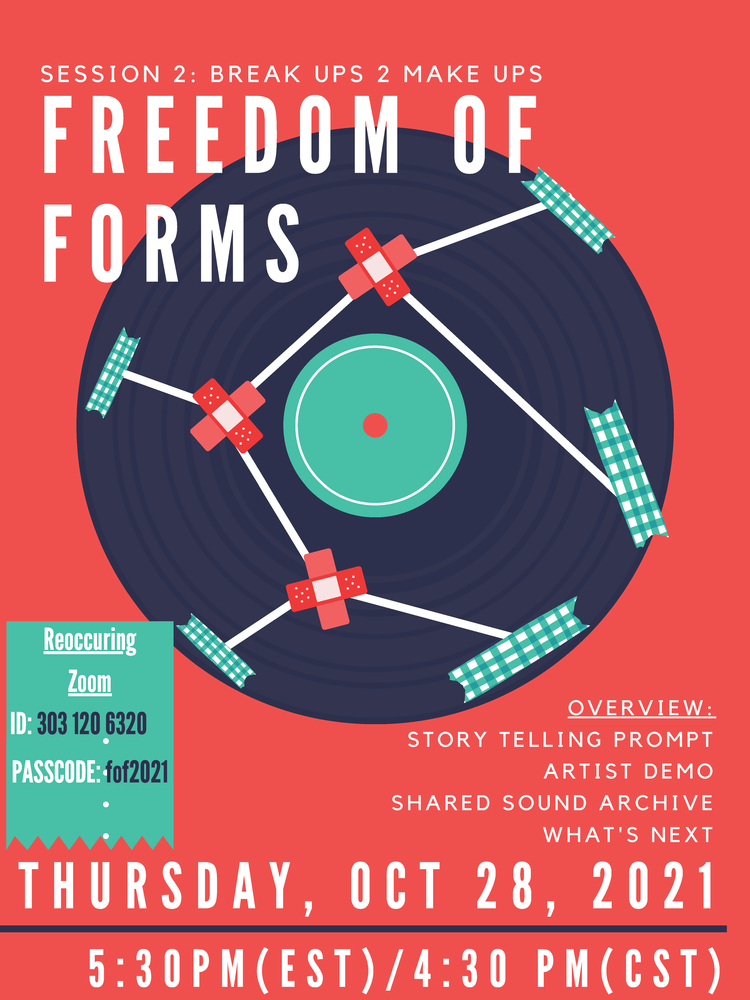
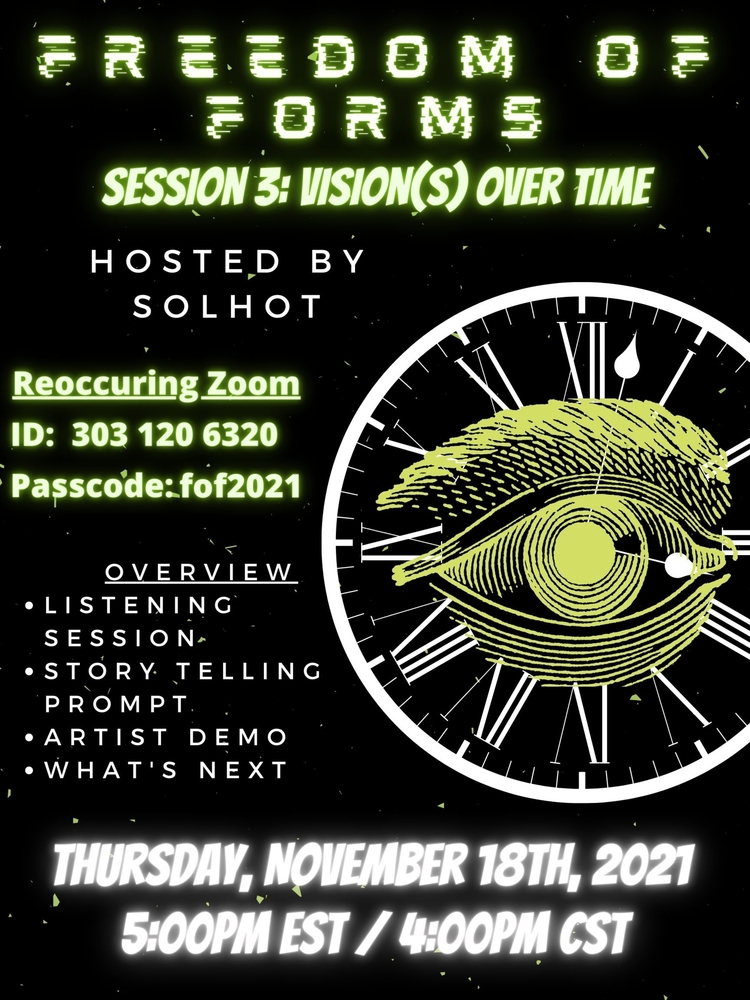
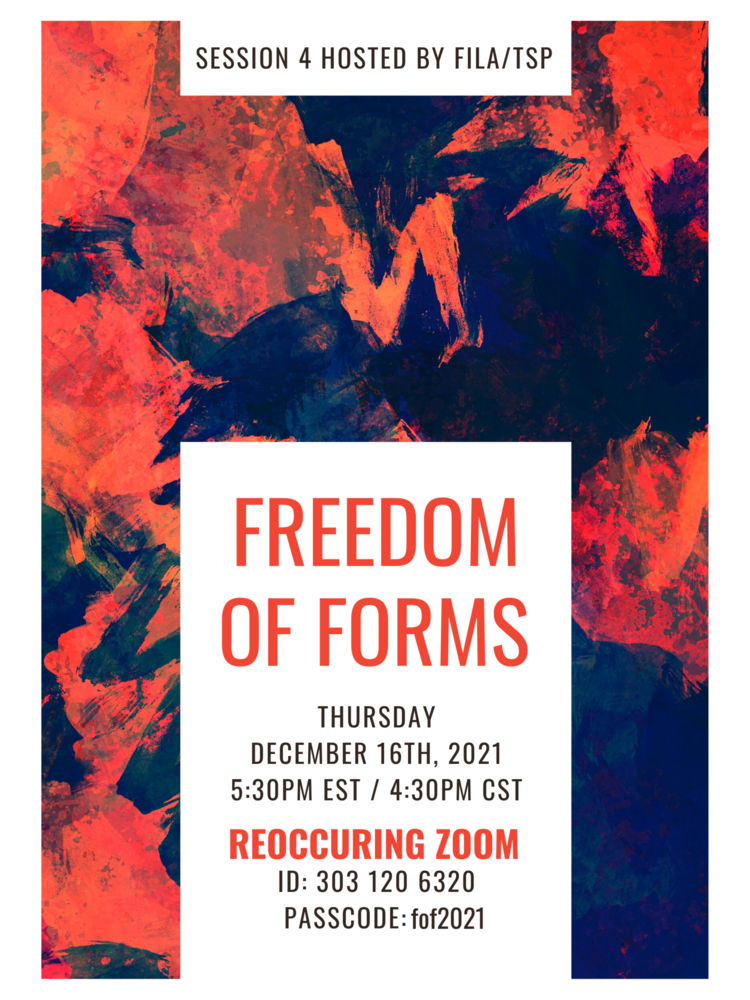
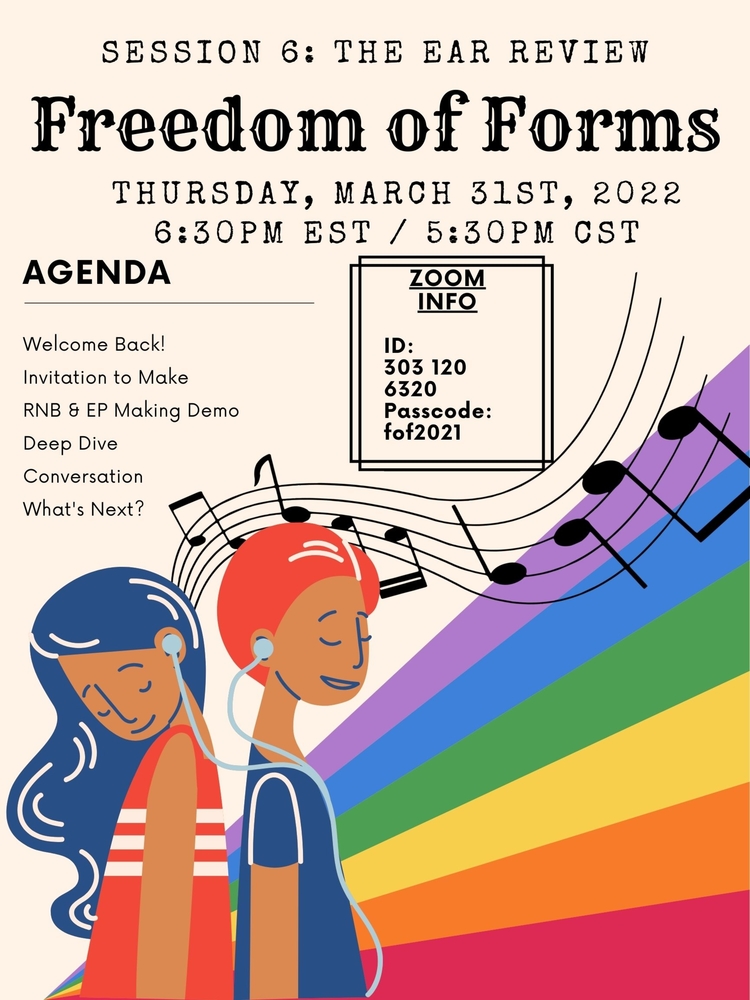
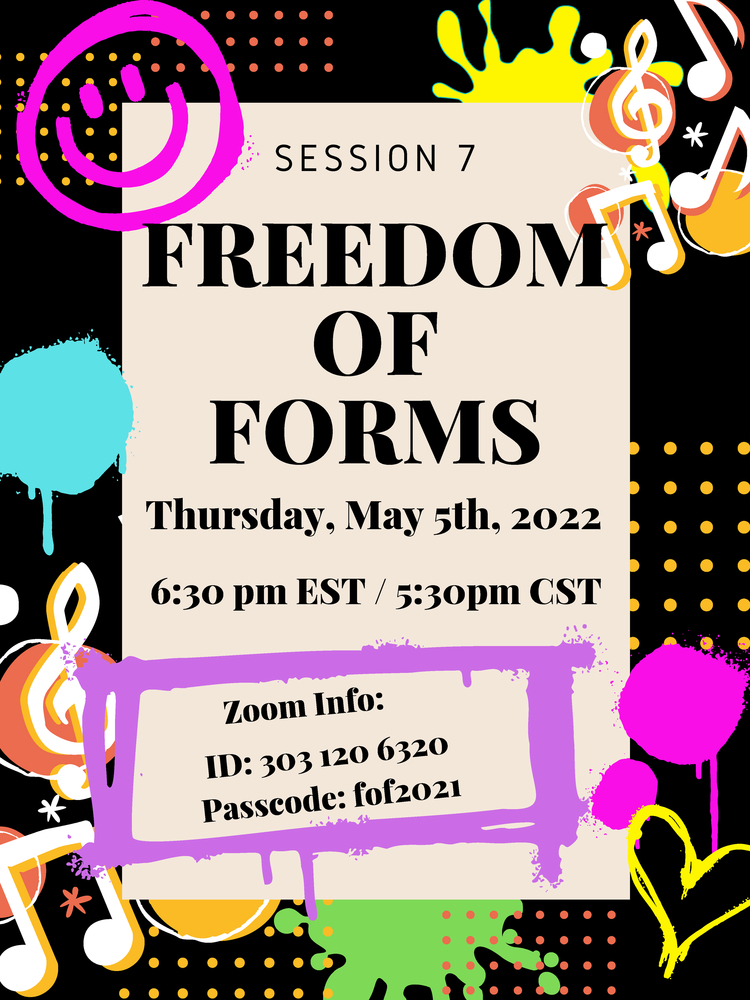
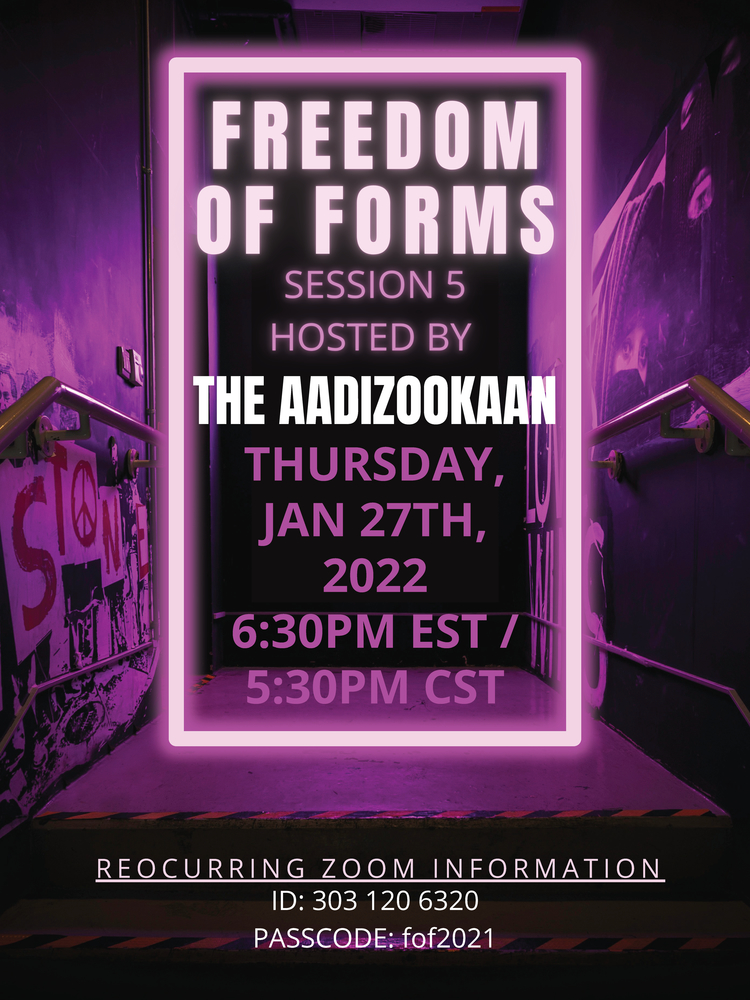
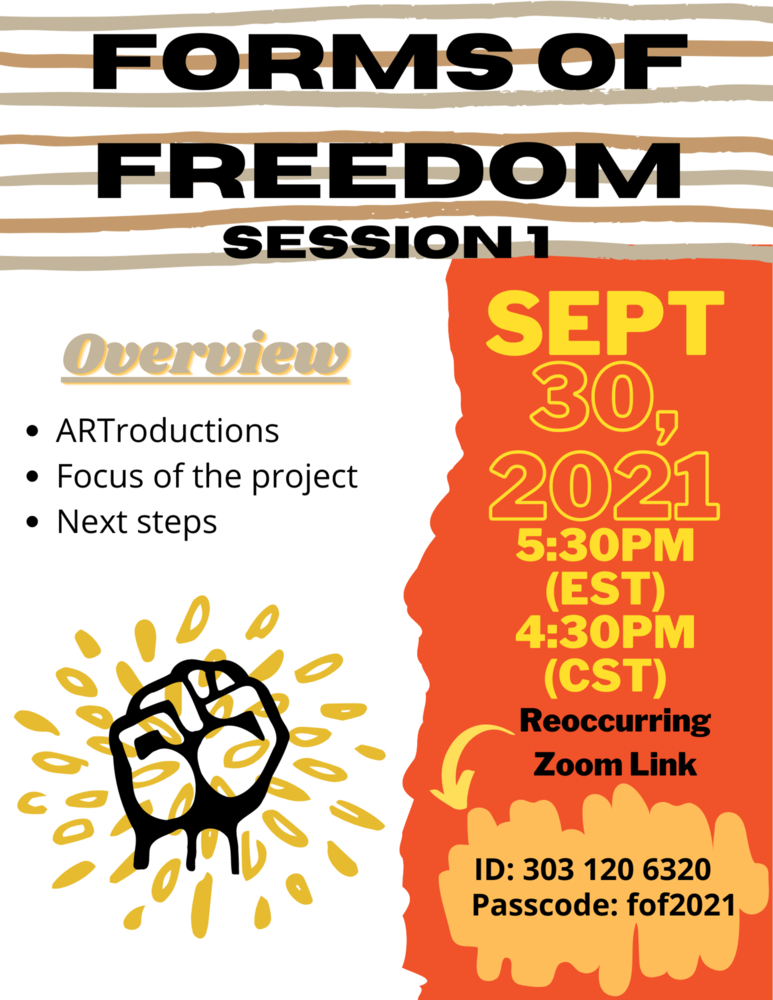
Figures 6-12. Flyers for Forms of Freedom exchange sessions, designed by Esmé R. Bailey. Many of the designs use images that point to the topic of the exchange session, as decided by the specific collective facilitating the session.
  • Figure 6.
    Orange and yellow event flyer with image of fist holding seeds. Event is Forms of Freedom, Sept 30, 2021, on Zoom.
    Esmé R. Bailey
  • Figure 7.
    Red and blue event flyer with image of a vinyl record. event is Freedom of Forms,Oct 28, 2021 on Zoom.
    Esmé R. Bailey
  • Figure 8.
    Black and yellow event flyer with image of an eye. Event is Freedom of Forms, Nov 18, 2021 on Zoom.
    Esmé R. Bailey
  • Figure 9.
    Red and blue event flyer with abstract painting image. Event is Freedom of Forms, Dec 14, 2021, on Zoom.
    Esmé R. Bailey
  • Figure 10.
    Rainbow colored event flyer with images of two people listening to music. Event is Freedom of Forms, Mar 31, 2022 on Zoom.
    Esmé R. Bailey
  • Figure 11.
    Blue, black, and purple event flyer with images of musical notes, hearts, and smiley faces.  Event is Freedom of Forms, May 5, 2022, on Zoom.
    Esmé R. Bailey
  • Figure 12.
    Purple and black event flyer with image of a hallway with graffiti writing.Event is Freedom of Forms, Jan 27, 2022 on Zoom.
    Esmé R. Bailey

Arts INTEGRATION

The first question asked in our initial exchange session, amidst great interest and excitement to be in community together, was if it would be possible for us to create together, and even be in the same space while we create, if the global pandemic might subside and allow it. This question, an intervention itself, expressed a shared directive for the art integration of this project. We welcomed and even anticipated this artistic pull from our assembly of poets and songwriters; singers and rappers; and Hip Hop, experimental, electronic, and classical music producers. 

As the facilitators of this project, we worked ourselves into a consistent routine of creating to process, make sense of, and think-feel through the evolution of the project. This routine consisted of Emery producing audio tune-ins, Ruth Nicole writing ritual performance scripts, exchanging these between us, and then gathering to process what we made in a conversation genre we called “deep dives.” This routine of creation and exchange allowed us to re-encounter the content and rhythms of the project (Brown & Petchauer, in press).   

Here is how we understood tune-ins and ritual performance scripts as ongoing, artful practices.

Emery on tune-ins: Composing sonically, through what I began calling "tune-ins," was a method of listening to the recorded exchange sessions in our shared archive. The process of composing afforded a kind of slowness and depth while processing the exchange conversations. Doing so caused me to tune-in to certain fragments of the conversation through loop and repetition. This is why I got to calling these pieces “tune-ins.” I was trying to do something beyond just representing the ideas or conversations.  I was putting the group back into conversation with one another, a kind of performative re-staging of these conversations, sometimes through the chance and indeterminacy afforded by the digital audio workstation in which I was creating. Rendering multivocality, splitting of speaker’s voices, layering of sound synthesis, and using the full range of the stereo field were artful approaches to re-staging these conversations. I also leaned into this kind of making because it produced sonic compositions that could be shared with our collaborators. This sharing was both for inspiration but also a method of ongoing exchange of what I was hearing in our conversation. 

Ruth Nicole on performance scripts: I wrote performance scripts because I wanted to do something akin to music but not have it be music per se. At least not music production. I thought variation in form was important because when we were together on Zoom, I delighted in our differences. I wanted and needed to see our sound put to paper to question how it what would reverb against and with what I remembered or personally experienced. I also felt an impulse to write us in a collective voice without references to specific individuals because we know each other in a way that is familiar and it was important to me to question what I thought was known. The scripts play with that by disidentifying a single author, in preference for a collective voice. The ideas presented could have emerged from any one of our collectives. After sharing and processing the scripts with Emery first, I knew they were more ritual based than anything. When I performed the script in public, I felt more of our wholeness. The music I heard but didn’t write or make obvious was instrumental with the script serving as a kind of lyrical invitation to wholeness, envisioned to invoke ceremony: bowls, bells, the sound of candles, incense, and communion.  

An example of this routine of re-encounter comes from our fourth exchange session. Led by Fire in Little Africa, the session gathered around the topic of integrity. This topic was relevant to Fire in Little Africa and the other collectives for how navigating capitalist, patriarchal, anti-Black, and anti-Indigenous organizations – in different ways for each collective – challenged the commitments, principles, and existence of the collectives – and, in some instances, the health and wellbeing of the people deemed to be leaders. To process the weight and layers of this topic, we turned to our routines described above: Emery composing a tune-in around integrity (Audio 1), and Ruth Nicole writing a ritual performance script around integrity (Figures 13-18) – both based upon the audio recording of this fourth exchange session. 

Audio 1. “Integrity" tune-in made after exchange session 4. There is oscillation between clarity and opacity in the Tune-In. For example, the phrase “I tried to protect people at all costs” loops throughout the piece but does not divulge who needs/needed protection. The situation that sparked this phrase, spoken by collaborator Stevie Johnson, remain opaque – known only to those in the presence and care of the exchange session. Additionally, there are multiple copies of Stevie’s voice that loop and sometimes overlap – thus oscillating between clarity and opacity – separated only through panning left and right in the stereo field of listening. Headphones recommended.

Listen to file directly

Figure 13. “Integrity" ritual performance script created by Ruth Nicole after exchange session 4 (continued in Figures 14-18). The utterance "Lives were put at risk" smears thrice across the page in performative red text. Between opacity and clarity, we do not subject this statement to some kind of case study analytical process. We don't even say whose lives were put at risk or how. Those in the presence and care of the exchange session know the answers. But offering this utterance, this refrain, as a performance in the script and not as datum for analysis, keeps the pain and violence around this refrain from becoming spectacle. This is because performance carries with it a certain refusal of analysis (Ruiz & Vourloumis, 2021).
Red letters on white background; Yall, ready/ for story time?/ Integrity/ What does integrity mean and how is/ it tested, individually and collectively?/ I had to look it up--/ Anybody can start.
Figure 14.
Red text on a white background: It's about the people you're working with/ and yourself--am I compromising myself and what's/ happening in front of me?/ Integrity is a huge concept./ What are we doing and what are we doing it for?/ Discipline and having the habits--even when circumstances/ change you know yourself and your vision and if it doesn't/ fall in line with what you see your integrity helps guide that./ It's a thick topic./ Lives were put at risk./ Lives were put at risk./ Lives were put at risk./ Somebody has to be blamed. Somebody has to be the/ scapegoat and that's obviously me./ So what happens when you see those experiences over/ and over again?/ (you not desensitized)/ Even when confronted with pearls and bowties/ We can still work here, and it is what it is/ What's the thing that YOU offer?
Figure 15.
Red text on a white background, in two columns. Left column: Wholeness/ Coalition/ Togetherness/ Truth to power/ Putting your life on the line/ Protect people at all costs/ Peace of mind. Right column: Changing lives/ Choosing sovereignty (over and over)/ Clarity/ Calling/ Lowered blood pressure/ Feeling freedom. Across the space (not in either column): What's the wholeness of this situation?
Figure 16.
Red text on a white background: Is integrity enough?/ They took my work away from me. Is integrity enough?/ It would be easy to be like, yeah...we not doing what they doing./ (when you have integrity you can't align yourself with people who/ don't have it)/ It's just kinda...sticky. Messy. A lot. It's isolating./ We're talking about people who've experienced trauma/ they entire lives./ Revolution still needed. Just knowing the things,/ they were taking away from me. They don't teach what/ we cherish./ Having someone on the squad enough with the shits to be like,/ we see that, and we see us and what we going to do? It's always what/ we gonna do?/ It feels like the horror that it is. The absolute horror that/ it is. This rage/ it's too much./ Authenticity is the only way to get their attention./ Assimilation doesn't have the same effect./ The leader is challenged by the collective./ It's still the collective, whatever your purpose is, follow that./ Encourage and inspire each other/ this the vision/ and however it looks and you feel about/ it is what it is--/ just be who you are./ (expect shame and grace to show up)
Figure 17.
Red text on a white background: Integrity first principle./ That is not how it's going to go--this is a non-negotiable;/ we gotta connect the dots./ How dare you come in here and tell us what to do?/ I'm trying to get you to understand/ the bigger picture/ Practicing integrity/ Providing historical context/ Making connections/ I worked hard for this moneybut if it means I can't talk/ about my experiences...I can't.../ Integrity is litmus test./ Yeah, I can read through the bullshit./ I can see peope for what they are./ I can see what people really want./ I gotta watch myself more./ (my power)/ The  second definition of integrity: the state of being whole.
Figure 18.
Red text on a white background: I trust you. It's about trust too./ I can lean on people, and I know who can hold me./ (there is the leader and there is everyone else)/ THis what our brand is/ This how we presenting ourselves This our identity/ We don't change/ It's uncomfortable/ It's not about me/ It's about controlling my narrative/ Questions and decisions about integrity/ happen through conversation/ But, what REALLY has integrity done for me?/ I would have thought at one point it was an issue of integrity and it's not/ My ideas change and evolve over time/ The collective conversation seem like an important part of it/ It took almost a month to get though my agreement/ (they utilized who I though was a friend)/ How are you feeling?/ *insert sound healing a ritual of remembering*
The “Integrity” tune-in and ritual performance script then became the inception point for a 12-minute audio paper, "The Second Sound of Integrity: Us Whole” (Audio 2), published in the Danish academic and sound art journal Seismograf Peer (Petchauer & Brown, 2023). 
Audio 2. Audio paper from this project published in Seismograf Peer, composed from tune-ins and ritual performance scripts. The audio paper loops and deconstructs the phrase "It feels like the horror that it is." Spoken by Ruth Nicole, the phrase maintains a degree of opacity by refraining from explaining what exactly this horror is. Additionally, there are degrees of sonic opacity to the phrase as well since it swirls about other layers of audio in the same band of frequencies and is subject to audio effects like distortion and feedback. What this means is that it isn’t always easy to make out the discursive meaning of what people are saying in the audio paper, as if the sounds are smeared across the listening field like ink across page. (For this reason, subtitles are not provided here.) Unlike most forms of popular music, where clarity of voice and lyrics is paramount, the sonic opacity in the audio paper activates an aesthetic performance of Black studies. Headphones recommended. See Groth & Samson (2016) for more on the audio paper genre. See also Mollin & Voegelin, 2024.

Listen to file directly

Emery Petchauer & Ruth Nicole Brown (2023) - https://seismograf.org/node/20195

The digital Ensemble & Ear review

The arts integration of our project expanded as we circulated our tune-ins and ritual performance scripts among our collaborators and invited them into this creative exchange as well. We asked everyone to access the materials in our shared archive to make something based upon their experience in this project. The open-ended nature of our invitation was a sign of our trust and admiration for the sensibilities these collaborators brought into the experience. Not surprisingly, many collaborators leaned into the medium of sound while sampling from our shared archive, echoing lines from ritual performance scripts, and composing original scores (Audios 3-6).  

Audio 3. "Jessica Hears Y'all," an audio piece created by Dr. Jessica Robinson based upon her experience in this collaboration, using material from the shared archive.

Listen to file directly

Jessica Robinson
Audio 4. "Just Give Me One Second," an audio piece created by Dr. Blair Ebony Smith (lovenloops) based upon her experience in this collaboration, using material from the shared archive.

Listen to file directly

Blair Ebony Smith / loven loops
Audio 5. "And Be Free," an orchestra piece composed by Am're Ford based upon the spiritual “Oh Freedom.” The interruptions and dissonance in the piece represent whiteness and other temporary distractions that don’t outlast the freedoms we experience.

Listen to file directly

Am're Ford
Audio 6. "What Do You Want," an audio piece created by Stevie "Dr. View" Johnson based upon his experience in this collaboration, using material from the shared archive.

Listen to file directly

Stevie "Dr. View" Johnson

The invitation around these pieces was rooted in a collective ethic we came to call “the ear review” — a play on the academic concept of peer review. The ear review meant that all of us are peers with the expertise and attunements to receive and review these sonic works of ours. The collective listening, feeling, and responding to one another’s art activated this ethic. At the same time, this ethic advanced our intervention to the objectification of research collaborators by locating the circle of collaborators itself as the first site of authority and interpretation. 

Going further, we constructed an online digital ensemble from the entirety of materials made during this project, inviting the public to engage with these creations. We understand the ensemble and its art not as representations of answers to how collectives sustain themselves over time. In other words, it is not a website communicating research findings. It is an assembly of art objects – sonic, visual, and discursive creations – in proximity with one another. The art is what happens, what is made, as these three collectives evolved to sustain themselves over time during the course of this experience. Play is encouraged. Start in the middle. Begin at any poetic phrase and wonderment will lead to another iteration of our sound. The ensemble is meant to spark rigor and wonder of curiosity (McKittrick, 2021) in those who engage with it.

Figure 19. Landing page of Forms of Freedom ensemble. The design of the landing page provides visitors multiple entry points to the ensemble. Strategically, there is no standard “About” page that would suggest a starting place. Instead, each poetic phrase is a portal of entry to arrive at one of the project’s artifacts and explore from there. The many portals perform an ongoing refrain of the project: “Start in the middle because that’s where we already are.”
The words "Forms of Freedom" in all capital letters fill a blue background. Titles of individual works appear in white typeface.
- www.formsoffreedom.com

People's Sound Studio 

As the pandemic subsided during the second year of this project, we further extended the arts-integration and collectivity of our project by designing a public studio event on-site at Teachers College, Columbia University in New York City. 

Figure 20. The People’s Sound studio was a half-day experiment in collectivism through the different studio practices of these collectives. Additionally, this event was a strategy to further open the borders of the project into new relations. The extension of the project was made possible by activating our existing solidarities with professors Bettina Love and Yolanda Sealey-Ruiz, both faculty members at Teachers College, Columbia University.
Brown, tan, and off-white event flyer. The event is People's Sound Studio with Freedom of Forms, Oct 24 at Teachers College, Columbia University.
Video 1. In an open studio format, attendees worked directly with our collaborators and ourselves by creating sonic collages, discussing rituals of creation, and listening-feeling the sonic creations of this project. With the collectives, we facilitated conversations with graduate students enrolled in Dr. Bettina Love’s Abolitionist Teaching and Hip Hop Education graduate courses. The People’s Sound Studio was an affirmative answer to the earliest ask from our collaborators: if the project would allow us to create together in situ.
Mark C. Francis II - https://www.youtube.com/watch?v=jUIDyjqpv8k

method and rhythm 

The arts integration of this project was a reflection and product of multiple things. As project facilitators, making art from the shared archive of materials was the method and rhythm of ongoing sensemaking against the fixity of social science case study methods. It was a way to go deep while acknowledging that performance and experimentation of artistic traditions is what our collectives shared in common. The respect within the group was also fodder for trusting ourselves to break from the disciplines in which we are trained and loosen from the ways we have routinized ourselves as professionalized scholars. Relying on our separate, incommensurable artistic practices and sensibilities created ways of defamiliarizing, synthesizing, and otherwise exploring what we were hearing and experiencing in the exchange sessions.

By taking this approach, we learned that collectives regenerate by the movement they create – with members moving through, moving on, and moving away. We learned that wholeness – individually and collectively – is an aspect of reseeding because of the ways settler colonial, patriarchal, and capitalist systems work to pull apart the integrity of collectives. (sidenote: A shout out to our collaborator Sacramento Knoxx for putting in play this idea of “reseeding” through stories of harvesting manoomin rice. ) We remembered how care, practices of love, and loving accountability are necessary to nourish collective agreements and desires.

Also for us, and for our collaborators, art making was related to what was happening in our lives at that time, external events, and memories of the work we were doing before the pandemic. Arts integration was not a direct response to our research question but rather became the process (more wholly of it all) that generated ways of exploring the initial research questions together that felt inspiring, relevant, and useful. Most viscerally, the art-making integrated through this project in and beyond the pandemic was a way to remember and to keep going, individually and collectively, even in absence of a next direct action, party, or session. 

References

Brown, R. N. & Petchauer, E. (2025). Routines of re-encounter: Sound practices in the art of the social. International Review of Qualitative Inquiry. https://doi.org/10.1177/19408447251319423

Combahee River Collective. (1977). The Combahee River Collective statement. Combahee River Collective.

Groth, S. K., & Samson, K. (2016). Audio papers – a manifesto. Seismograf Peer. https://doi.org/10.48233/SEISMOGRAF1601

Harney, S. and Moten, F. (2013). The undercommons: Fugitive planning and Black study. Minor Compositions.

McKittrick, K. (2022). Dear April: The aesthetics of black miscellanea. Antipode, 54(1), 3-18.

Maparyan, L. (2012). The womanist idea. Routledge.

Mollin, D. & Voegelin, S. (2024). Audio papers: An introduction. Slowing down and breaking up of scholarship into the deliberate vagueness of sonic criticality. Glissando. https://audiopapers.glissando.pl/audio-papers-an-introduction/

Nembhard, J. G. (2014). Collective courage: A history of African American cooperative economic thought and practice. The Pennsylvania University Press.

Petchauer, E., & Brown, R. N. (2023). The second sound of integrity: Us whole [audio paper]. Seismograf Peer. https://doi.org/10.48233/09

Ruiz, S., & Vourloumis, H. (2021). Formless formation: Vignettes for the end of the world. Minor Compositions.

Smith, B. E. (2024). Take it on. Emergent literacy, 6. https://emergentliterary.com/sonic-summer-24/lovenloops

Stake, R. (2005). Multiple case study analysis. The Guilford Press.

van Hesswijk, J., Hlavajova, M., & Rakes, R., eds. (2021) Toward the not-yet: Art as public practice. MIT Press.


Footnotes

  1. Ruth Nicole started SOLHOT in 2006, Emery has ongoing collaborations with members of The Aadizookaan, and both Ruth Nicole and Emery love and admire Fire in Little Africa / The Space Program. Our collaborators across these collectives were Esmé R. Bailey, Am’re Ford, Mark C. Francis II, Stevie “Dr. View” Johnson, Sacramento Knoxx, Dr. Jessica Robinson, Dr. Blair Ebony Smith, and Jacobi Ryan.
  2. A shout out to our collaborator Sacramento Knoxx for putting in play this idea of “reseeding” through stories of harvesting manoomin rice.
x

Acknowledgements

This project was funded by a racial equity research grant from the Spencer Foundation.

Supporting Materials


Contributors

Emery Petchauer: Conceptualization, Formal Analysis, Funding acquisition, Investigation inquiry, Methodology, Production - Creative, Production - Social, Project administration, Reflective Analysis, Relationship Development Outreach, Supervision, Visualization, Writing – original draft, Writing – review & editing
Ruth Nicole Brown: Conceptualization, Formal Analysis, Funding acquisition, Investigation inquiry, Methodology, Production - Creative, Production - Social, Project administration, Reflective Analysis, Relationship Development Outreach, Supervision, Visualization, Writing – original draft, Writing – review & editing
Esmé R. Bailey: Data curation, Production - Creative, Production - Social, Project administration
Sean Deyoe: Production - Creative Visualization
Bettina Love: Production - Social Relationship Development Outreach
Yolanda Sealey-Ruiz: Production - Social Relationship Development Outreach
Sacramento Knoxx: Production - Creative Production - Social
Stevie Johnson: Production - Creative Production - Social
Mark Francis II: Production - Creative, Production - Social, Visualization
Blair E. Smith: Production - Creative Production - Social
Jessica Robinson: Production - Creative Production - Social
Jacobi Ryan: Production - Creative Production - Social
Am're Ford: Production - Creative Production - Social

Roles

Conceptualization: Emery Petchauer, Ruth Nicole Brown.
Formal Analysis: Emery Petchauer, Ruth Nicole Brown.
Funding acquisition: Emery Petchauer, Ruth Nicole Brown.
Investigation and inquiry: Emery Petchauer, Ruth Nicole Brown.
Methodology: Emery Petchauer, Ruth Nicole Brown.
Production - Creative: Emery Petchauer, Ruth Nicole Brown, Esmé R. Bailey, Sean Deyoe, Sacramento Knoxx, Stevie Johnson, Mark Francis II, Blair E. Smith, Jessica Robinson, Jacobi Ryan,, Am're Ford.
Production - Social: Emery Petchauer, Ruth Nicole Brown, Esmé R. Bailey, Bettina Love, Yolanda Sealey-Ruiz, Sacramento Knoxx, Stevie Johnson, Mark Francis II, Blair E. Smith, Jessica Robinson, Jacobi Ryan,, Am're Ford.
Project administration: Emery Petchauer, Ruth Nicole Brown,, Esmé R. Bailey.
Reflective Analysis: Emery Petchauer, Ruth Nicole Brown.
Relationship Development and Outreach: Emery Petchauer, Ruth Nicole Brown, Bettina Love,, Yolanda Sealey-Ruiz.
Supervision: Emery Petchauer, Ruth Nicole Brown.
Visualization: Emery Petchauer, Ruth Nicole Brown, Sean Deyoe,, Mark Francis II.
Writing – original draft: Emery Petchauer, Ruth Nicole Brown.
Writing – review & editing: Emery Petchauer, Ruth Nicole Brown.
Data curation: Esmé R. Bailey.
denotes by-line credit.

Completed

Between September 2021 and August 2023

Website:

Project Site

Sites and Institutes

Michigan State University
Teachers College, Columbia University

Keywords

Collaboration; Collective Action; Public Interest Design Black Studies Sound Art Performance Activism Collective Participation

Disciplines

Black Studies Performance Studies

Views

675 views